
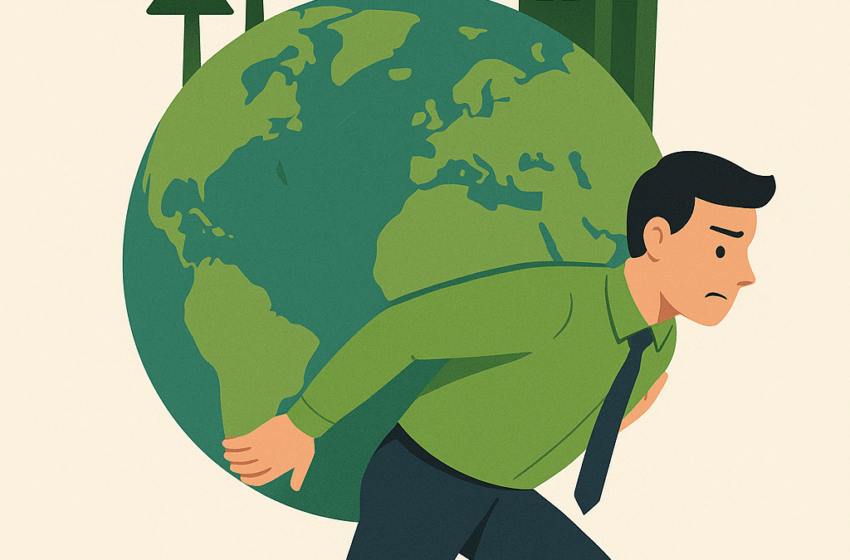
Carrying capacity who carry
After the concept of sustainability gained prominence, there has been now a noticeable upsurge in the use of the term “beyond the limit and carrying capacity.” This term was introduced by the Western world, especially in the 1970s, when American ecologists began to use it. The underlying idea was that if we exploit the Earth’s resources beyond their limits, we will inevitably face catastrophic consequences. While sustainability has frequently been included in our plans, policies, and projects, the unfortunate reality is that there is hardly anything today that we can genuinely label as sustainable. . We continue to use the term sustainability, but, truthfully, we often do not understand its real meaning. Sustainability can be defined as a process that begins with subsistence, leads to surplus, and finally results in sharing. Any resource or any other commodity—can be called sustainable only if it follows this model.
In today’s world, sustainability is defined based on convenience or interest. When a project or industry begins to generate income and appears to sustain itself financially, it is quickly labeled as sustainable. But we rarely take the time to assess if the industry is consuming natural resources whethar it repays its ecological debt to the Earth. Unfortunately, inclusivity is not prioritized in most of our policies and plans.
The term “carrying capacity” is now widely used, especially in discussions about systemic breakdowns, particularly in human settlements. This concept came into mainstream discourse during the Joshimath disaster in 2023,that took Global attention where a small village swelled into a town on top of a fragile mountain. It was because,the bearing capacity of that hillock was never considered, and over time, unplanned development led to severe consequences. It served as an example of what happens when we overburden a settlement without understanding its environmental thresholds.
Morever,every hillock has a river flowing at its base, continuously eroding the bottomland and making it prone to landslips. That is the story of Joshimath—and, more broadly, of carrying capacity. Following the disaster, the Chief Minister was advised to initiate a review of the carrying capacity of most towns in Uttarakhand. Besides the rapid and unregulated influx of tourists into sensitive mountain areas has also become a major concern. As a result, the government formed a committee of experts from top institutes to study the issue. Ironically, the report is yet to be made public. But honestly, we don’t need a report to understand that exploiting land or any resource beyond its limit will result in serious problems . This has been the unfortunate reality of mountain areas.
There is yet an intact issue where do we stand ecologically today? In the mountains, fragility and marginality are critical issues. Historically, due to inaccessibility, mountain regions have been marginalized, which is why infrastructure development became the main priority for the governments of hill states. But the question, is it only the mountains that are crossing their limits, or is this happening everywhere?
. Himachal Pradesh was granted statehood in 1960s, followed by Jammu & Kashmir in the Western Himalayas, and Uttarakhand about 25 years ago. Back then, climate change, global warming, and flash floods were not pressing concerns for policymakers. Hence, these states focused on developing infrastructure for farming, forestry, and other basic amenities . The first Chief Minister of Himachal Pradesh, Dr Yashwant Singh Parmar, had a clear vision of development. He prioritized agriculture, recognizing it as the livelihood backbone for most households. He established the University of Horticulture and Forestry and built roads to connect local produce with urban markets. This topped HP in economic boost among many struggling states in the country. But now, the Himachal Pradesh is one of the most threatened states during every monsoon season.
Among the three Western Himalayan states—Himachal Pradesh, Jammu & Kashmir, and Uttarakhand—development outcomes have varied. Jammu & Kashmir’s growth was hindered by political and social challenges. It has not experienced as many natural catastrophes as Himachal Pradesh and Uttarakhand. Since gaining statehood, Uttarakhand has repeatedly faced disasters, making it relatively more cautious about the t development. Yet, due to strong public demand, the government undertook infrastructure projects that, over time, proved environmentally costly. A poor understanding of natural systems, combined with inappropriate use of technology and scientific methods, has contributed to many of these disasters. Roads in the mountains, for instance, require special design considerations—techniques and time line used in the plains cannot be blindly applied. Here, Slope stability and terrain sensitivity must seriouly be accounted for.
In Himachal Pradesh, for example, development over the last six decades often ignored ecological limits. Townships developed in the past four to five decades now seem more threatening than supportive. In recent years, the state has suffered from intense flash floods, landslips, and landslides—many of which are not just due to present-day decisions but are consequences of development choices made 50–60 years ago, when changing rainfall patterns and climate-related threats were unimaginable.
If we rank Himalayan states by the frequency of disasters, Himachal Pradesh comes first, followed by Uttarakhand, with Jammu & Kashmir experiencing fewer events. If we compare this with the development index, we find Himachal ranks first, Uttarakhand second, and Jammu & Kashmir third. This shows a clear link between development intensity and disaster vulnerability.
We should not restrict our analysis to Indian states alone. Globally, similar patterns exist. Over the past decade, the U.S. has witnessed the highest number of disasters, followed by China and India. Interestingly, these three nations are also among the world’s most developed or fast-developing economies. A study conducted in 1990,already pointed out this trend, suggesting a clear correlation between development and disaster frequency.
We must also look at urban areas, which are severely overburdened and have high pace, 17 percent growth rate now. No city can honestly claim to be within its sustainable limits. Indian cities are choked with vehicles, people, and concrete. Over the last three decades, cities have become suffocating spaces. Delhi is a prime example. The city is collapsing under the pressure of unplanned development, heavy traffic, and overpopulation. It is one of the most polluted cities globally. In the National capital, the Yamuna River, once a lifeline, is now one of the dirtiest rivers. Life in the city is increasingly difficult, with basic services and health under constant threat. Studies reveal that air pollution here is a leading cause of child mortality in Delhi. Groundwater is heavily contaminated with harmful chemicals. And Delhi is not alone—most Indian cities have already exceeded their limits.
This urban crisis is largely driven by the migration of people seeking better education, healthcare, and lifestyle. Youth especially view urban areas as centers of opportunity. Currently, 35% of India’s population lives in urban areas, compared to the global average of 55%. By 2050, this figure is projected to cross 50% in India. But this shift comes at a undefined price.
When villages are abandoned, what becomes of the primary productivity of the land—its forest,farms, rivers, and soil? Urban centers will eventually face a deep crisis, not only of natural resources like water and air but also of social and psychological well-being. Studies have linked climate change to rising mental health issues such as climate anxiety and depression. A walk through a forest can uplift one’s mood, while city life, dominated by concrete and chaos, leads to emotional fatigue.
Thus, carrying capacity is not just a mountain issue—it is a national and global concern. Our vital resources—rivers, water bodies, air soil, and forests—are all under increasing pressure. The balance between biotic and abiotic components is being disrupted. The global human population has crossed 8 billion, while natural resources are becoming increasingly scarce and inaccessible.
So, how do we move forward? The answer lies in managing both rural and urban ecosystems effectively. There are many rural communities that have remained stable because they are self-sufficient in what they produce and consume. Their quality of life is equal to that of urban dwellers. This strikes thst climate change and global warming are of course global issues, but solutions will be local. Since large land and Population are still in rural domain, the answer to climate change coping and mitigation lies here only
The future must focus on revitalizing rural areas. Strengthening village economies will naturally curb urban overcrowding. But this can only happen when basic amenities—health, education, infrastructure—are adequately provided in rural zones. As a fast growing economy, India must create a balance between rural and urban development, to be an example to others.
Although the government has taken steps, rural economies are still far weaker than urban ones. This challenge is not unique to India; it is global. Addressing climate change cannot be limited to reducing carbon emissions. It must involve inclusive, grassroots-level strategies.
For mountain region and elsewhere too, Special attention is needed for infrastructure development.. Past development was often arbitrary and ecologically insensitive. Now, infrastructure must be based on ecosystem principles, designed for all ecological regions. Development should not be denied to remote mountain or rural communities, but it must be within ecological permissible limits,design and execution.
Only by adopting this approach we can truly balance economy and ecology. Ironically, it is rural populations who suffer most from the impacts of climate change—even though it is urban lifestyles that are the primary cause of environmental damage. While rural communities may not contribute significantly to GDP, they play a vital role in sustaining the environment through preservation of soil, forests, and water—resources. They contribute to what might be called the “Gross Environmental Product.”GEP, which the rest of the world constantly enjoys. GDP is detrimental to the Ecosystem while GEP is reliving.